
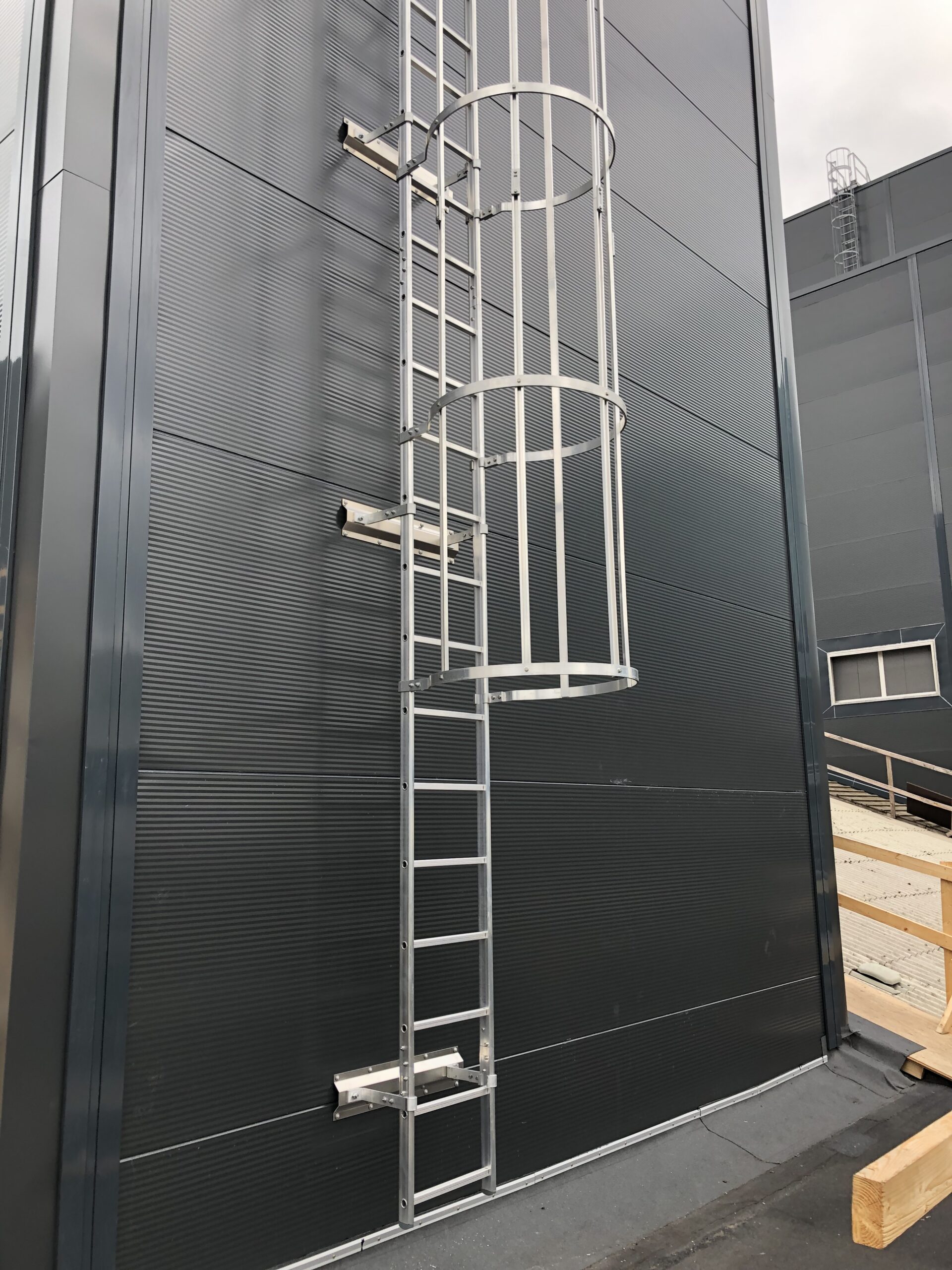
Den rigtige adgangsløsning
Hvorfor vælge en EN 14122-4 godkendt lejder frem for en specialfremstillet svejset lejder? Når der skal etableres adgang til tage,…

As a regular part of our fall protection courses, we always talk about anchor points and the requirements for them. But it is one thing to know what the law says and what the user's responsibility is when constructing a temporary anchor point. It is another thing to know what equipment you can use as an anchor point.
The other day I saw a construction of a temporary anchor point that worried me a little. The user had made a loop around an I-beam via a connecting rope, and connected the rope via a carabiner back around the rope itself, and was thus “tied” in place. See the image for illustration:

In English this is called a tie-back, and some equipment is actually approved and tested for this operation. However, the rope used was approved to EN354, which forms the group of restraint lines and work positioning etc., and as the rope only had this standard printed on it, it must NOT be used in this way.
Furthermore, there is an inappropriate load on the carabiner in the event of a fall. This puts the user in an unfortunate situation if an accident occurs, and there is a real chance of a break if the energy in the fall is high enough. Which could have catastrophic consequences.


That is why, it is important to know your equipment and be able to read the data on it. Here are 2 examples, where the first is a work rope, approved exclusively for restraint / positioning, while the second image is a wire anchor strap, which may actually be used both as an anchor point (EN795) and restraint (EN354).
In the above example, the most correct solution would be to have a wire or polyester strap connected around the beam, and here to connect your work rope! A good and safe solution, as the wire stopper is both sharp-edged and heat-resistant.
But it's not always that easy, see for example this excerpt from Petzl's Grillion. A piece of equipment that has several functions. Among other things, the possibility of using it as an anchor strap.

As can be seen, the rope can be connected around a structure, after which the rope is untied and can now be used to connect your work rope, or similar. This means that you as a user must always be one step ahead in terms of how you use your equipment in use. Which in turn requires and emphasizes – Know your equipment!!


