Vedligehold dit udstyr – det betaler sig
Arbejder du med faldsikringsudstyr uden for, i støvende miljøer eller i områder med kemi eller anden kemisk påvirkning, bør du…
New equipment and gear is great, but when it comes to safety at height, it is not always beneficial to replace equipment too often. There are always new developments in fall protection equipment, and it takes time to keep up with new products, standards and recommendations. That is why we typically advise our customers to buy equipment that they and their people know so that there is no doubt about how the equipment should be used.
It can be tempting to be lured by online stores and / or the DIY market's "universal fall protection sets", but the fact is that the task determines the equipment, and you can rarely use such a set for several types of tasks. In some cases, this can be associated with great risks using these universal sets. A good example is fall blocks / yo-yos, which are sold in countless variations, with widely varying specifications.
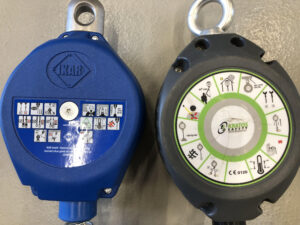
The picture shows two 6 meter fall arresters, which basically have the same function. To slow down the fall energy and lock the user in the event of a fall. However, there are some very important differences – the blue Ikar block can be used in all directions, i.e. above the user and lying down, the other block cannot. The clearance under the user is also different, a parameter that is absolutely crucial for the user's safety.
Another example is carabiners, in this area there is really a lot of new happening. Both in material and function. Basically, a carabiner used for fall protection must be approved according to the EN 362 standard. The challenge is that there are several types of connectors that can be used for fall protection, and which are approved according to EN 362, but which require the user to have knowledge of the product.
An extreme example of where this becomes clear is pipe carabiners, also called tube anchors, see Tube anchor 140mmA tube anchor is used in situations where the user creates a temporary anchor point around a pipe installation. The advantage of a tube anchor is that it does not move, unlike an anchor wire, see Ankerwire 1 m, which will typically move with the user. However, a pipe anchor is approved according to EN 362, and thus in theory a carabiner.
So in principle you must use a tube anchor, as shown below!!
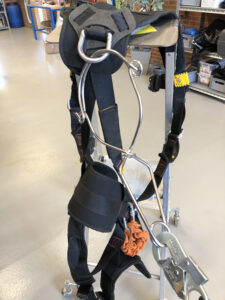
Which of course makes no sense.
Nevertheless, it shows very well how important it is to know your equipment and its basic properties. And that new equipment cannot just be put into use without thorough instruction. Here it is important to remember the Danish Working Environment Authority's guidance on fall protection, see AT guidancethat:
This is a valid argument for giving your employees a course, in the use of fall protection and rescue, but also an argument for not jumping on everything new equipment manufacturers present, unless the task cannot be solved without it.